

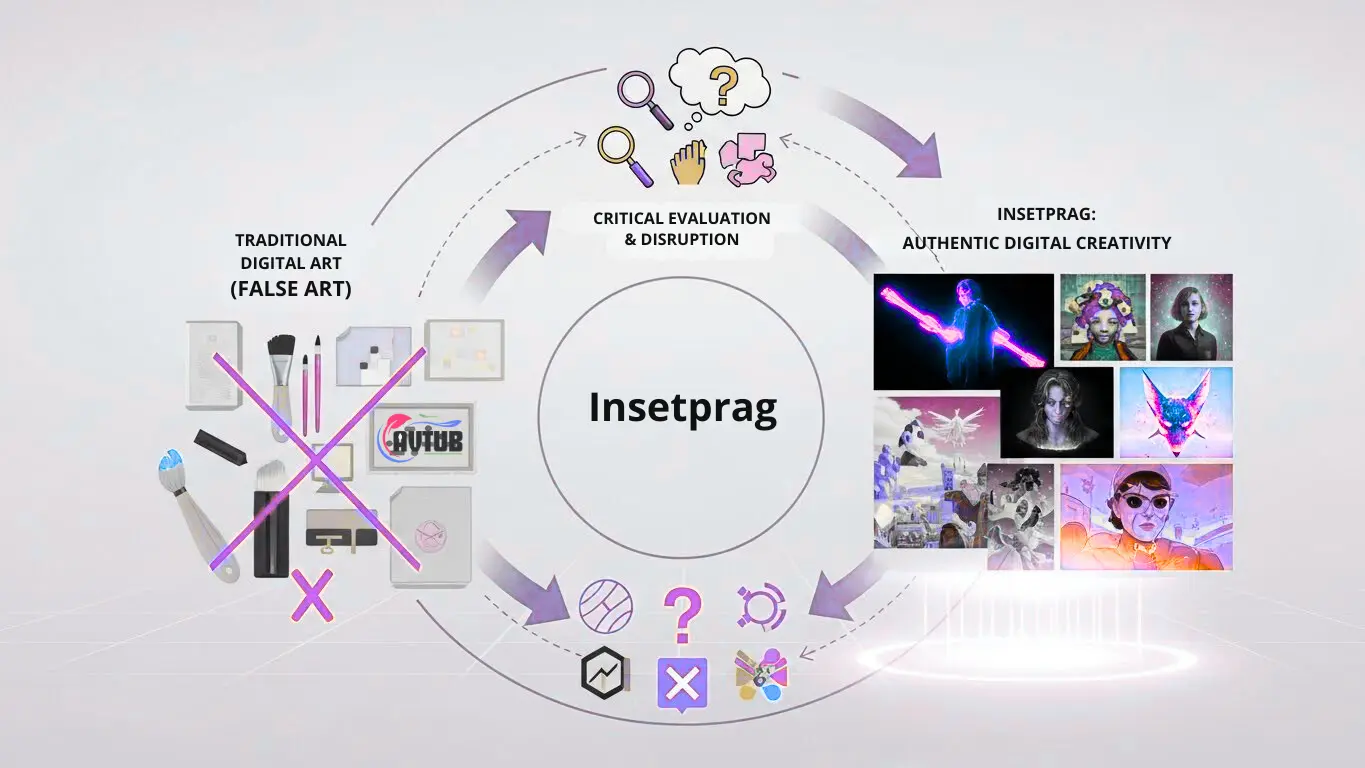
We are living in a strange time for creativity. You open your social media feeds and are bombarded with images that look perfect but feel empty. Vibrant landscapes that don’t exist, portraits of people who never lived, and designs that follow a mathematical average rather than a human impulse. This is the era of “False Art” content that mimics creativity without the pulse of a creator. But amidst this noise, a new philosophy is quietly emerging. It is called Insetprag. It isn’t just a buzzword; it is a necessary correction. Insetprag represents a modern shift in digital creativity that prioritizes Insight over algorithms and Pragmatism over perfection. If you have ever felt that digital art is losing its soul, this post is your roadmap back to authenticity.
What is Insetprag
At its heart, Insetprag is a portmanteau of two words: Insight and Pragmatism. It is the philosophy that true digital creativity must start with a human insight a feeling, a story, or a lived experience and use technology only as a pragmatic tool to express it. It rejects the idea that “more is better.” In a world where AI can generate a thousand images in a minute, Insetprag asks: “Which one of these actually matters?” It is the discipline of inserting human intention into the pragmatic sets of digital tools.
The Rise of “False Art” and Why We Are Tired of It
To understand Insetprag, we first have to name the problem. “False Art” refers to the wave of hyper-polished, soul-less content flooding the internet. It is technically impressive but emotionally hollow. It’s the result of prompting a machine to “make something beautiful” without asking why. False Art chases engagement metrics and algorithm preferences. It is candy for the eye but starvation for the soul. The audience is starting to notice. We are craving imperfections, textures, and choices that show a human was behind the screen.
Implementing Insetprag in Your Work
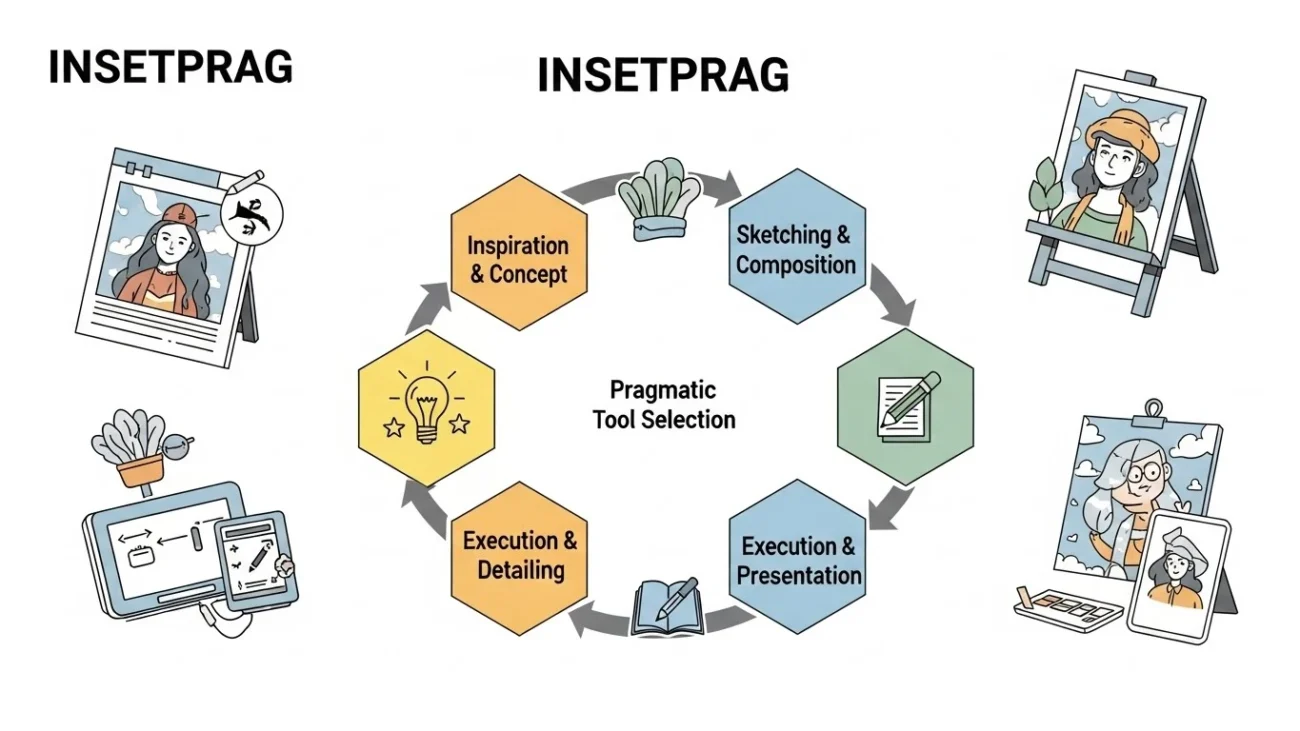
Shift From “Prompting” to “Crafting”:
The biggest shift Insetprag demands is moving away from passive creation. When you use a “False Art” workflow, you might type a prompt and pick the best result. That is curation, not creation. In an Insetprag workflow, you might use AI to generate a texture, but then you collage it, paint over it, distress it, and force it to fit your vision. You are the director, not just the audience.
The “Insight First” Rule:
Before you open your software, stop. Ask yourself: “What is the insight here” Are you trying to capture the feeling of rain on a hot sidewalk, Are you trying to visualize the chaos of modern dating, If you don’t have an insight, don’t start designing. False Art starts with “What looks cool” Insetprag starts with “What is true”
Visual Characteristics of Insetprag Art:
How do you spot Insetprag art in the wild? Look for these signs:
- Mixed Media: A blend of 3D rendering with hand-drawn scribbles.
- Narrative Depth: Images that tell a story beyond just being a pretty portrait.
- Restraint: Just because the software can add a million lighting effects doesn’t mean it should. Insetprag art often uses empty space (negative space) effectively.
Insetprag vs. False Art (Comparison)
The Critical Differences:
To make this crystal clear, let’s look at a direct comparison. This table highlights why Insetprag is the superior approach for long-term creative relevance.
| Feature | False Art (Pure AI/Algorithm) | Insetprag (Modern Shift) |
| Origin | Derived from data averages and patterns. | Derived from human insight and experience. |
| Goal | To please the algorithm / Visual perfection. | To express truth / Pragmatic communication. |
| Process | Passive (Prompt & Pick). | Active (Insert, Edit, Mold, Refine). |
| Feel | Shiny, hollow, often “uncanny valley.” | Textured, grounded, relatable. |
| Value | Low (easily replicable). | High (unique human signature). |
| Longevity | Fades as soon as the tech improves. | Timeless because it relies on story. |
Why This Matters Now
The Fatigue of Perfection:
We have reached “Peak Gloss.” 4K screens and perfect render engines have made perfection cheap. When everything is perfect, nothing is special. We are seeing a return to “ugly” design, brutalism, and lo-fi aesthetics because they feel real. Insetprag captures this cultural mood. It says, “I am human, and I am here,” which is the most valuable signal you can send in the 2020s.
Protecting Human Creativity:
If we don’t adopt Insetprag, we risk forgetting how to create. If we rely solely on generators, our creative muscles atrophy. Insetprag is a workout for your imagination. It demands that you solve problems, not just ask software to solve them for you.
FAQs
Is Insetprag against using AI tools?
No. Insetprag is not Luddite. It encourages using any tool (including AI) as long as it is done pragmatically and with human insight. It opposes lazy use of AI where the machine makes all the decisions.
Where did the term Insetprag come from?
The term has emerged from digital art communities discussing the “post-AI” landscape. It combines “Inset” (to place inside/integrate) and “Prag” (pragmatism), symbolizing the integration of human utility into digital art.
Can a beginner practice Insetprag?
Absolutely. In fact, beginners are often better at it because they haven’t learned to rely on shortcuts yet. If you draw something that looks “bad” but feels “true,” you are practicing Insetprag more than a pro who generates a “perfect” generic image.
Why is it called “Beyond False Art”?
“False Art” is a critique of the flood of synthetic media that lacks intent. Insetprag moves beyond this by acknowledging that while synthetic media is here to stay, it must be guided by human hands to become “Real Art” again.
Conclusion
Insetprag is more than a trend; it is a survival strategy for the digital age. As the internet fills up with noise, the only way to stand out is to offer something that a machine cannot: your unique perspective. By shifting your focus from “how does it look” to “what does it mean”, you move beyond False Art and into a realm of creativity that is sustainable, fulfilling, and undeniably human.