Key takeaway:
Constipation in Crohn’s disease is hardly ever a fiber or water problem. It usually comes from one of four things a narrowed stretch of bowel, an inflamed rectum that won’t empty, pelvic floor muscles that clamp shut when they should let go, or a medicine such as an opioid or an iron tablet. Each one needs a different treatment, and the first one on that list, a stricture, can be turned into an emergency by the fiber supplements most people try first. Finding the cause has to come before any laxative.
People think of Crohn’s as a diarrhea illness. Doctors often do too. So when a Crohn’s patient comes in constipated, it gets written off as something separate and treated with psyllium and more water. For some that works. For somebody with a narrowed loop of small bowel, the psyllium can be what tips them into an obstruction.
Constipation is far more common in Crohn’s than the textbooks let on. In a national survey of newly diagnosed children, almost half had no diarrhea at all. Adults whose disease sits in the ileum can spend years with slow, painful, never-quite-finished bowel movements before anyone links it to the Crohn’s. This piece goes through the causes that actually come up in clinic, how each is told from the others, and what sorts each one out.
Strictures: Scar Tissue That Narrows The Bowel
Crohn’s inflames the whole thickness of the bowel wall, not just the lining. After enough rounds of inflammation and healing, scar tissue builds up, and scar tissue shrinks and stiffens. The result is a stricture, a stretch of bowel that has narrowed. The terminal ileum, where the small bowel joins the colon, is the usual spot. About half of all people with Crohn’s get a stricture at some stage.
Think of a kink in a garden hose. Stool backs up behind it, the bowel upstream stretches, and the person feels full, bloated and crampy, especially after eating. Nausea and vomiting follow. Some stool still gets through, so patients are often told they can’t be blocked, but the “something is stuck” feeling they describe is generally right.
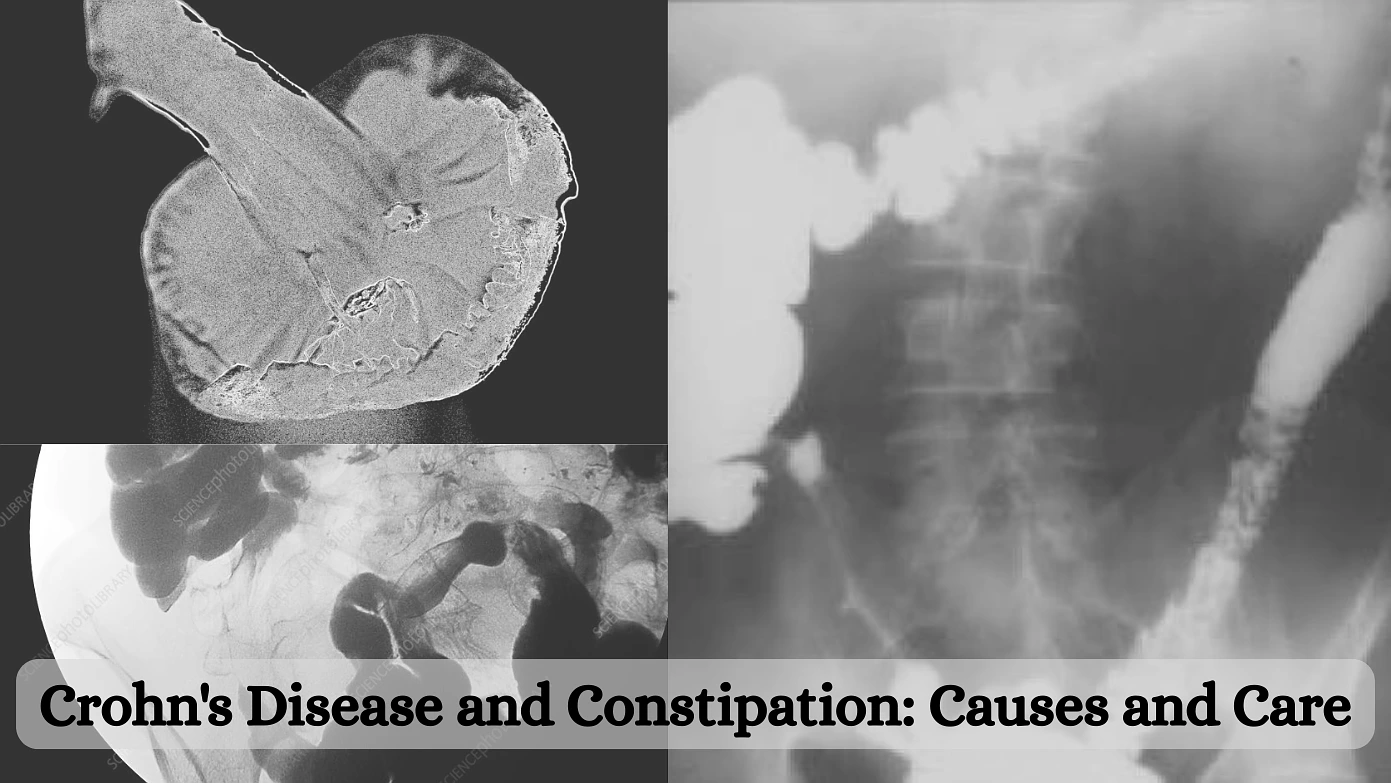
The stool test most gastroenterologists order first, fecal calprotectin, shows whether there’s inflammation but not where it is or whether the bowel has narrowed. To see a stricture you need imaging that shows the wall: MR enterography, CT enterography, or bowel ultrasound, which is quicker and has no radiation. A short stricture can sometimes be stretched with a balloon passed through an endoscope, which avoids surgery.
Why The Standard Crohn’s Scores Miss Constipation
The Harvey-Bradshaw Index and the Crohn’s Disease Activity Index, the scoring tools used in most clinics and trials, give points for liquid or soft stools per day, for abdominal pain and for general well-being. There’s no line for a day with no bowel movement. Straining, bloating and the blocked feeling don’t count.
So a patient with a tight stricture can score as “mild.” The symptoms are real and can be dangerous, but the form says all is well. Anyone with Crohn’s who feels brushed off because their score looks fine should say plainly that the score doesn’t measure what they’ve got. Delay has a cost. In the Swiss IBD Cohort Study, the longer it took to reach a diagnosis, the more complications adults went on to have.
Proctitis: An Inflamed Rectum That Feels Full But Won’t Empty
When the inflammation is in the rectum, the pattern confuses everyone. The person feels a constant need to go, visits the bathroom a dozen times a day and passes almost nothing. That’s tenesmus: an irritated rectum sending a “full” signal when it isn’t.
The inflamed rectum also doesn’t squeeze properly, so stool that reaches it sits there and hardens. The patient is urgent and constipated at the same time. Sometimes liquid stool slides around the hard mass, which looks like diarrhea but is actually an impaction. Laxatives make it worse. What fixes it is treating the inflammation itself, with rectal preparations first and stronger therapy if the lining won’t heal.
Pelvic Floor Dyssynergia: Muscles That Tighten When They Should Relax
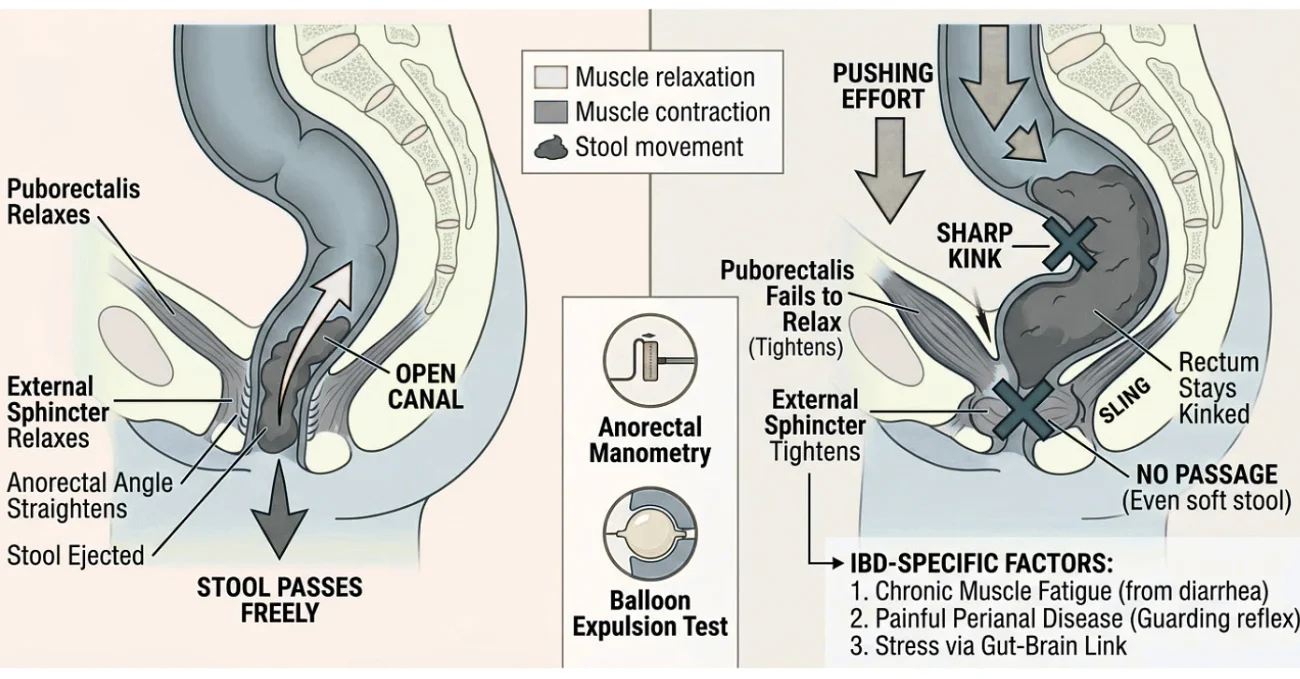
A muscle called the puborectalis loops round the rectum and holds it kinked shut at rest. To pass stool, it and the external sphincter have to relax. In dyssynergia they do the opposite and tighten, so the rectum stays kinked and no amount of pushing moves even soft stool through.
It turns up in IBD far more than people expect. In one study of IBD patients referred for ongoing trouble passing stool, 67% had constipation and all but one met the test criteria for dyssynergia. Years of diarrhea leave the muscles tired or in spasm; painful perianal disease teaches the body to clench; the stress of a long illness feeds the same reflex through the gut-brain link.
The giveaways are chronic straining, never feeling finished, and needing a finger to help stool out. Laxatives barely help, because the stool isn’t hard, it’s held. The tests are anorectal manometry, which measures pressure in the anal canal, and a balloon expulsion test, where a small balloon is placed in the rectum and the patient is asked to pass it.
Biofeedback: Retraining The Pelvic Floor Without Drugs Or Surgery
Dyssynergia is the one cause on this page that a physical therapist can fix. In biofeedback, sensors on the skin or just inside the anal canal show the patient their own muscle activity on a screen while they practice bearing down. Most are startled to watch the muscles clench when they thought they were pushing. Over a handful of sessions they learn to do the reverse.
The results are real. Among IBD patients with dyssynergia who finished a biofeedback course, 30% reached a meaningful improvement in quality-of-life scores. Pelvic floor therapists who know IBD are still thin on the ground, so it’s worth asking the gastroenterologist for a named referral rather than hoping one gets offered.
Medicines That Constipate Crohn’s Patients
Opioids, whether for Crohn’s pain or something else, slow the gut, pull water out of the stool and tighten the sphincters. Taken long term they can cause what some doctors call narcotic bowel syndrome, where the painkiller becomes the main source of the abdominal pain and the constipation. The way out is cutting down or switching the opioid, with a laxative plan built for opioid constipation in the meantime. Bulk laxatives do little here.
Oral iron, given for the anemia that comes with Crohn’s, is the other. Ferrous sulfate especially hardens stool and slows things down. Options are a lower dose, a different formulation, alternate-day dosing, or an intravenous iron infusion, which a lot of IBD clinics now prefer because it skips the gut altogether.
Antispasmodics, some antidepressants and calcium- or aluminum-based antacids can pile on. Every tablet and supplement, including the over-the-counter ones, belongs on the list at each appointment.
Post Inflammatory IBS And Gut Bacteria Once A Flare Has Settled
Plenty of Crohn’s patients in full remission, with a normal calprotectin and a clean scope, still have bowel symptoms. The usual label is post-inflammatory IBS: the flares have left the gut’s nerves oversensitive and its rhythm off, so it behaves like irritable bowel long after the inflammation has gone. When the main complaint is constipation it’s called IBS-C.
Bacteria play a part too. Some gut bacteria make methane, which slows transit. In small intestinal bacterial overgrowth, SIBO, bacteria that belong in the colon take up residence in the small bowel and cause bloating, gas and, in some people, constipation rather than diarrhea. A breath test picks up the methane producers. A dietitian may try a low-FODMAP diet, which cuts the fermentable carbohydrates that feed the overgrowth. That diet is restrictive and Crohn’s patients already run short of nutrients, so it’s done with supervision, not from a website.
Tests In Specialized Crohn’s Constipation Care
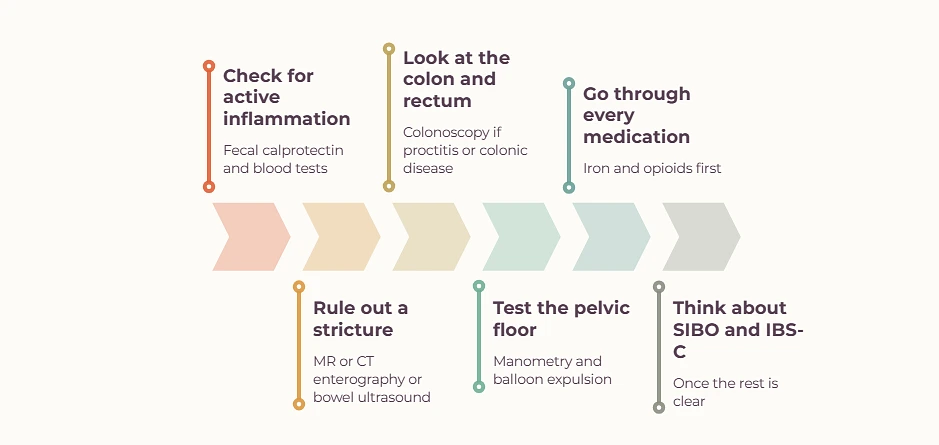
Because the treatments contradict each other, the order of investigation matters as much as the tests. Specialized Crohn’s constipation care runs in this sequence:
- Check for active inflammation with fecal calprotectin and blood tests.
- Rule out a stricture before anything else, with MR or CT enterography or bowel ultrasound, whenever there’s bloating, post-meal pain, nausea or a history of ileal disease. No bulk laxative or fiber supplement until this is done.
- Look at the colon and rectum by colonoscopy if proctitis or colonic disease is possible.
- Test the pelvic floor with manometry and balloon expulsion if the trouble is straining and incomplete emptying rather than hard stool.
- Go through every medication, iron and opioids first.
- Think about SIBO and IBS-C once the rest is clear.
Skipping the second step is where the harm happens. Fiber and bulk laxatives in front of a stricture can pack stool, or a ball of undigested fiber, against the narrowing and cause a complete blockage.
Matching The Treatment To The Cause
Once the cause is clear, treatment is usually simple.
For constipation with no stricture, an osmotic laxative like polyethylene glycol is the standard first choice. It draws water into the stool without adding bulk. Soluble fiber can be brought in slowly after that, and it may do more than relieve constipation: in a group of 1,619 people with Crohn’s in remission, those eating the most fiber were less likely to flare than those eating the least. For anyone with a known stricture the advice flips: a low-residue diet to keep stool small and soft, and no bulking agents at all.
Secretagogues, newer prescription drugs that increase fluid in the bowel, are the next step when polyethylene glycol isn’t enough. Dyssynergia gets biofeedback. Proctitis gets anti-inflammatory treatment. Opioid or iron constipation gets a change of medicine. An IBD dietitian fits the diet to whichever applies.
Warning Signs That Mean The Emergency Room, Not A Laxative
- No stool and no gas for a prolonged period.
- Severe or worsening abdominal pain, especially in one spot or with tenderness.
- Vomiting green or yellow fluid.
- A swollen, tight abdomen.
- Fever, above all in anyone on immunosuppressive medication.
- Dizziness, very little urine, extreme thirst.
Together these point to a complete obstruction, a perforation or, rarely, toxic megacolon. They need an emergency department, not a message to the clinic.
General information, not medical advice. Anyone with Crohn’s disease and new or worsening constipation should talk to their gastroenterologist, and go to an emergency department with any of the warning signs above.
References:
- Perera LP, et al. Dyssynergic defecation: a treatable cause of persistent symptoms when inflammatory bowel disease is in remission. Digestive Diseases and Sciences, 2013: https://pubmed.ncbi.nlm.nih.gov/23817920/
- Brotherton CS, et al. Avoidance of fiber is associated with greater risk of Crohn’s disease flare in a 6-month period. Clinical Gastroenterology and Hepatology, 2016: https://pubmed.ncbi.nlm.nih.gov/26748217/
- Schoepfer AM, et al. Diagnostic delay in Crohn’s disease is associated with a complicated disease course and increased operation rate. American Journal of Gastroenterology, 2013: https://pubmed.ncbi.nlm.nih.gov/23896955/
- Harvey RF, Bradshaw JM. A simple index of Crohn’s disease activity. The Lancet, 1980.
- American College of Gastroenterology, Management of Crohn’s Disease in Adults guideline: https://gi.org/guidelines/