It’s 3:47 p.m. You meant to draft the report at ten in the morning. You have, somehow, opened your inbox forty-one times since then. There’s a coffee cup at your elbow that you don’t remember pouring. A friend has texted twice. You read both messages, didn’t answer either, and now feel slightly guilty about that on top of everything else.
This is the experience the word “neurowellness” is trying to address, even if the word itself sounds like something a wellness brand invented to sell you a journal. (Some of them did.) The useful version of the term covers the actual stuff: how the brain holds attention, what wears it down, and what genuinely rebuilds it. Most of what’s in this article you’ve probably read in some form before. Read it anyway. The order matters. So does what’s usually missing.
Key Points
- Six hours of sleep, sustained over two weeks, produces cognitive impairment comparable to two nights of total sleep deprivation. The catch is that the people experiencing it usually report feeling fine.
- Every task switch leaves a residue of the previous task hanging in your head, which is why your brain feels coated in something thick by late afternoon.
- Heavy multitaskers score worse on attention filtering, not better. Practice doesn’t save you here.
- Eight weeks of mindfulness practice has been shown to grow measurable gray matter in regions tied to learning and emotion. The brain remodels.
- A year of moderate walking added measurable hippocampal volume in older adults, reversing one to two years of normal age-related shrinkage. Walk first, think after.
- Most gains come from removing things, not adding them. Notifications, apps, browser tabs, the phone within arm’s reach.
Where the Focus Actually Goes
Distraction isn’t quite the right word for what’s happening. The right word is leak. When you pull yourself away from one task to glance at another, your attention doesn’t snap cleanly over. Some of it stays behind, like a browser tab in your head that refuses to close. A researcher named Sophie Leroy at the University of Washington Bothell ran experiments on this in the late 2000s. People interrupted mid-task and asked to do something else carried the first task into the second. Their performance on the new task dropped. They didn’t notice it had dropped.
The interesting part of Leroy’s work is the asymmetry. Switching from an easy task to a harder one is worse than the reverse. Switching when you weren’t done is worse than switching at a natural stopping point. The fix isn’t to never switch. The fix is to finish, mentally, before you do.
That last bit is harder than it sounds. Finishing means tolerating the discomfort of not opening Slack until the document is actually closed. Most people can’t do it for the first three or four days. The discomfort is the training.
Layer on top of that what Eyal Ophir, Clifford Nass, and Anthony Wagner found at Stanford. They expected heavy media multitaskers to be sharper at filtering distraction because of all the practice. They tested it. Heavy multitaskers were worse at every cognitive control task in the battery. Worse at task switching, worse at filtering, worse at memory under interference. Nass, before he died, used to give talks where he said this finding shocked his lab. They ran the experiment three times trying to make it come out the other way. It kept not.
A Short Detour Through the Wiring
You have two networks competing for your forebrain. The first one runs through the prefrontal cortex and the parietal lobe and is sometimes called the executive network, which sounds important and is. It’s the thing that holds your current goal active and tells the rest of the brain what to ignore. The second one runs in the background. It’s called the default mode network because it’s what your brain does by default when you’re not directing it. Daydreams. Inner monologues. Replays of the conversation from this morning that you should have handled differently.
Both networks are useful. The default mode is where most creative connections happen, which is why you have your best ideas in the shower. The problem isn’t that one network is bad. The problem is that for a lot of modern adults, the executive network gets switched off by phone-checking before it has time to do anything, and the default mode runs constantly without producing anything useful, just rumination on loop.
Training focus is partly learning to keep the executive network online longer. And partly learning to let the default mode finish a thought before you yank attention away from it.
This isn’t woo. Britta Hölzel and Sara Lazar’s team at Mass General put adults through an eight-week mindfulness program and scanned their brains before and after. Gray matter density in the hippocampus and several other regions measurably increased. Eight weeks isn’t nothing. It also isn’t very long.
The Unfair Lever
There’s an awkward truth in this genre that nobody wants to lead with: most adults reading this could solve sixty percent of their focus problem by sleeping more, and they will keep refusing.
Hans Van Dongen and David Dinges, working at the University of Pennsylvania in the early 2000s, ran an experiment where adults slept four, six, or eight hours a night for two weeks. The four-hour group was a wreck, as you’d expect. The six-hour group surprised them. By the end of the two weeks, their attention performance had degraded to the level of someone who had been awake for two straight nights. None of the six-hour subjects rated themselves as severely impaired. Their self-reports were close to baseline. Their actual output was not.
Six hours feels normal. Six hours isn’t normal.
Find the actual lights-out time that gives you seven and a half to eight hours, and hit it for a week. Then come back and assess whether you still have a focus problem. A lot of people stop being interested in the rest of the toolkit at this point because the problem mostly resolves itself.
Two more notes on this, the boring kind that nobody quotes on social media:
- Bedrooms should be cold. Around 65°F or 18°C is the range that keeps showing up in the sleep literature. Most people sleep their bedrooms five to ten degrees warmer than that and don’t know why their sleep is bad.
- The phone is the problem, and not for the reason health & wellness articles usually give. It isn’t “the blue light.” It’s that the phone produces tiny, intermittent dopamine hits at exactly the moment you should be winding down, and your brain learns to anticipate them. Charge it in another room.
Move First, Think Second
Kirk Erickson and a team at the University of Pittsburgh and Illinois ran a year-long trial. One group walked, building from ten minutes to forty over a couple of months. The other did stretching and toning. The walking group’s hippocampal volume increased by about two percent. The stretching group’s continued to shrink, as is normal with age. Two percent doesn’t sound like much. In hippocampus terms it’s roughly the reversal of one to two years of normal aging, in one year of walking.
The mechanism is something called brain-derived neurotrophic factor, or BDNF, which is basically fertilizer for neurons. Exercise produces it. The effect is dose-dependent and shows up within months.
A few practical things that don’t usually make the list:
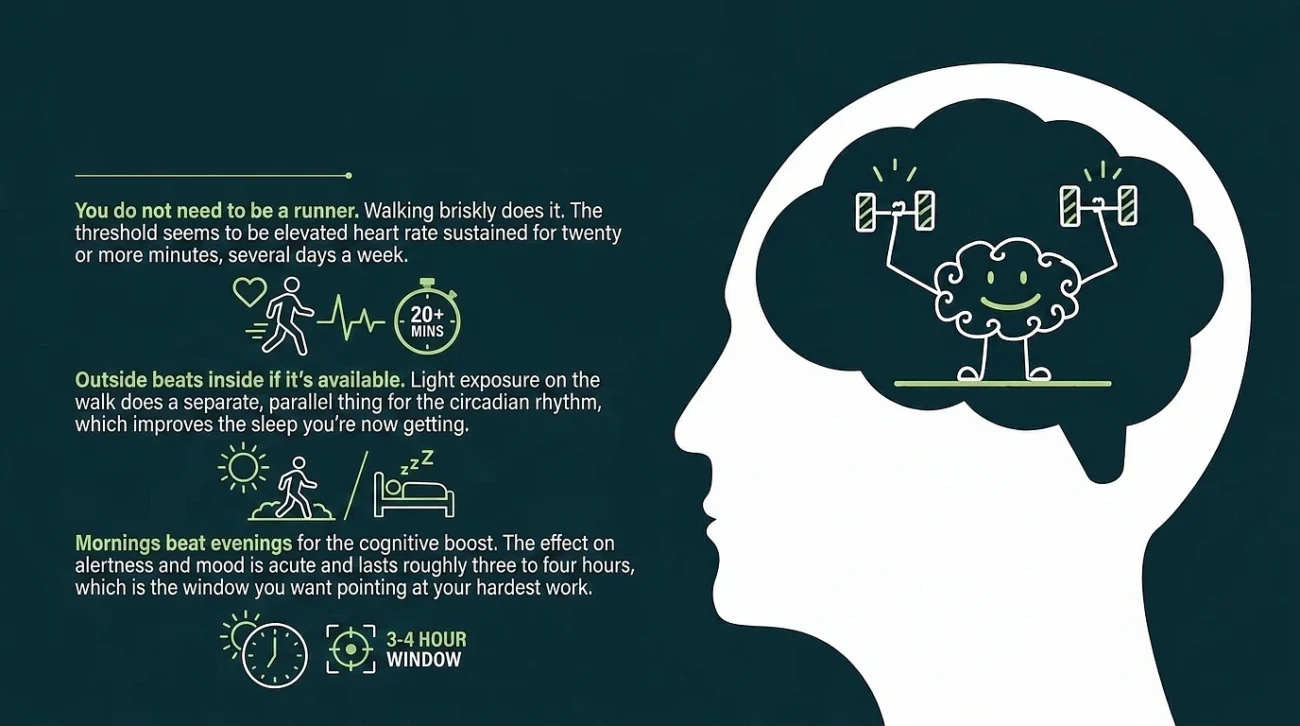
- You do not need to be a runner. Walking briskly does it. The threshold seems to be elevated heart rate sustained for twenty or more minutes, several days a week.
- Outside beats inside if it’s available. Light exposure on the walk does a separate, parallel thing for the circadian rhythm, which improves the sleep you’re now getting.
- Mornings beat evenings for the cognitive boost. The effect on alertness and mood is acute and lasts roughly three to four hours, which is the window you want pointing at your hardest work.
Meditation, Minus the Incense
People resist meditation for two reasons. They’ve tried it for ten minutes, found it boring, and concluded it didn’t work. Or they’ve been pitched it by someone who described it in language that sounded vaguely religious and made them want to leave the room.
Both reactions are fair. They’re also a separate problem from whether the thing works.
The cleanest evidence comes from Michael Mrazek’s group at UC Santa Barbara, who ran a randomized trial against an active control (a nutrition class, which is a better control than the usual “do nothing”). After two weeks, the mindfulness group’s GRE reading scores went up. So did their working memory. The improvement tracked closely with reduced mind-wandering during the test. The mechanism is exactly what it sounds like. Trained attention shows up as fewer mental health detours during cognitive tasks.
Amishi Jha at the University of Miami has run versions of this on active-duty military, where the failure mode of poor attention is somewhat worse than a bad GRE score. Same pattern. Short-form mindfulness training protected attention and working memory during high-stress periods when both would otherwise collapse.
The mechanics, stripped of the language: you sit. You pick a focus point, usually the breath. Your mind wanders. You notice it wandered. You bring it back. That noticing is the rep. The rep is what trains.
Ten minutes a day, done before the work starts, is enough. Doing it after work is mostly relaxation, which is fine but a different goal.
The Actual Workday, Working
Most productivity advice falls apart in a real job because it assumes the writer can control their own calendar. Cal Newport’s Deep Work is unusual in that he wrote it as a professor at Georgetown and was straightforward about the parts that don’t generalize. The core argument holds anyway. The most valuable cognitive work requires uninterrupted concentration on something difficult. The modern environment is designed against this. The fix is to schedule concentration the way you schedule meetings, and defend it as seriously.
The version that survives in jobs with real meetings looks roughly like this:
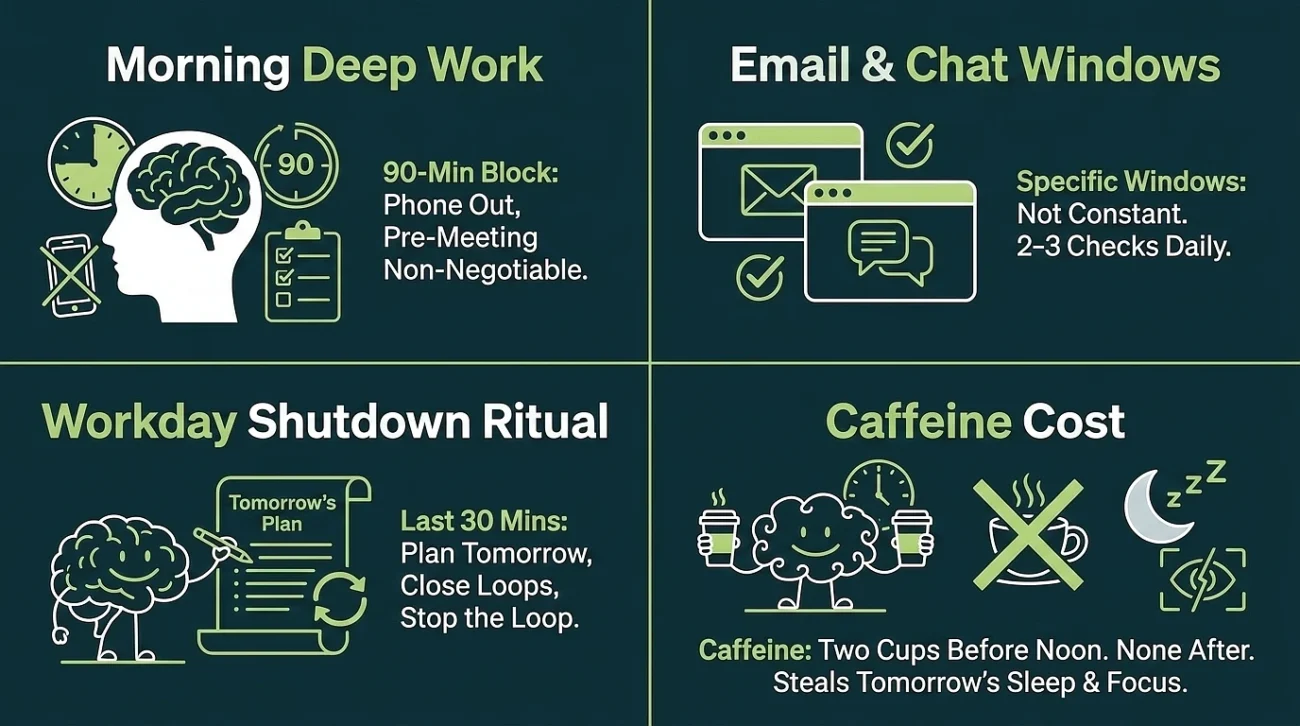
- One ninety-minute block in the morning, phone out of the room, before the day’s first meeting. This is the non-negotiable. Everything else flexes around it.
- Email and chat get specific windows, not constant attention. Two or three checks a day is enough for almost any job that isn’t customer support. People who claim they can’t do this usually can.
- The last thirty minutes of the workday are a shutdown ritual. Write tomorrow’s plan. Close the loops you can close. Note the ones you can’t. The point is to stop the brain running the day on a loop after you close the laptop.
- Caffeine has a cost. Two cups before noon, none after. The afternoon double espresso steals from tomorrow’s sleep, which steals from tomorrow’s focus, which is why you needed the double espresso.
If you implement only one of these, make it the morning block. The other ones compound on top of it. Without it, they don’t.
The Subtraction Nobody Wants to Do
This is supported by a study Adrian Ward and colleagues at the University of Texas at Austin ran in 2017, with nearly 800 participants. They assigned people to keep their phone in one of three locations during a cognitive test: on the desk, in a pocket or bag, or in another room. Performance dropped in a clean gradient. Best in the room next door, worst on the desk. The phone was silenced and powered off in all conditions. It didn’t matter. The brain spends background resources resisting the urge to check, and that resistance is overhead you could be spending on the work.
Same principle applied to the rest of the digital surface:
- Notifications off, app by app. Not silenced. Off.
- Browser opens to a blank tab, not a feed. Feeds are designed to be sticky. Removing the launch point removes most of the visit.
- Social apps on a phone screen no further than two pages in. Out of sight, off the dock.
- Slack, Teams, and other group chats are not real-time mediums even when used that way. Set status to a heads-down message and ignore them for two hours. The world will be there at noon.
When the Protocol Doesn’t Help
Sometimes the sleep is fixed, the walking is happening, the phone is in the drawer, and the focus still won’t come.
That’s worth taking seriously rather than grinding through. Persistent inability to concentrate, especially when it comes with low mood, loss of interest, heaviness in the body, or a sense that thinking has become physically effortful in a way it didn’t used to be, is not a discipline problem. Untreated sleep apnea looks a lot like ADHD. Hypothyroidism looks a lot like depression. ADHD looks like ADHD. Perimenopause looks like all three at once. Long COVID has thrown a fourth shape into the mix that researchers are still mapping.
References:
- Leroy, S. (2009). Why is it so hard to do my work? The challenge of attention residue when switching between work tasks. Organizational Behavior and Human Decision Processes, 109(2), 168–181 – https://www.sciencedirect.com/science/article/abs/pii/S0749597809000399.
- Ophir, E., Nass, C., & Wagner, A. D. (2009). Cognitive control in media multitaskers. Proceedings of the National Academy of Sciences, 106(37), 15583–15587 – https://www.pnas.org/doi/10.1073/pnas.0903620106.
- Hölzel, B. K., Carmody, J., Vangel, M., Congleton, C., Yerramsetti, S. M., Gard, T., & Lazar, S. W. (2011). Mindfulness practice leads to increases in regional brain gray matter density. Psychiatry Research: Neuroimaging, 191(1), 36–43 – https://pubmed.ncbi.nlm.nih.gov/21071182/.
- Van Dongen, H. P. A., Maislin, G., Mullington, J. M., & Dinges, D. F. (2003). The cumulative cost of additional wakefulness: dose-response effects on neurobehavioral functions and sleep physiology from chronic sleep restriction and total sleep deprivation. Sleep, 26(2), 117–126 – https://academic.oup.com/sleep/article/26/2/117/2709164.
- Erickson, K. I., Voss, M. W., Prakash, R. S., et al. (2011). Exercise training increases size of hippocampus and improves memory. Proceedings of the National Academy of Sciences, 108(7), 3017–3022 – https://www.pnas.org/doi/10.1073/pnas.1015950108.
- Mrazek, M. D., Franklin, M. S., Phillips, D. T., Baird, B., & Schooler, J. W. (2013). Mindfulness training improves working memory capacity and GRE performance while reducing mind wandering. Psychological Science, 24(5), 776–781 – https://journals.sagepub.com/doi/10.1177/0956797612459659.
- Jha, A. P., Morrison, A. B., Dainer-Best, J., Parker, S., Rostrup, N., & Stanley, E. A. (2015). Minds “at attention”: mindfulness training curbs attentional lapses in military cohorts. PLoS ONE, 10(2), e0116889 – https://journals.plos.org/plosone/article?id=10.1371/journal.pone.0116889.
- Ward, A. F., Duke, K., Gneezy, A., & Bos, M. W. (2017). Brain drain: The mere presence of one’s own smartphone reduces available cognitive capacity. Journal of the Association for Consumer Research, 2(2), 140–154 – https://www.journals.uchicago.edu/doi/10.1086/691462.
- Newport, C. (2016). Deep Work: Rules for Focused Success in a Distracted World. Grand Central Publishing.