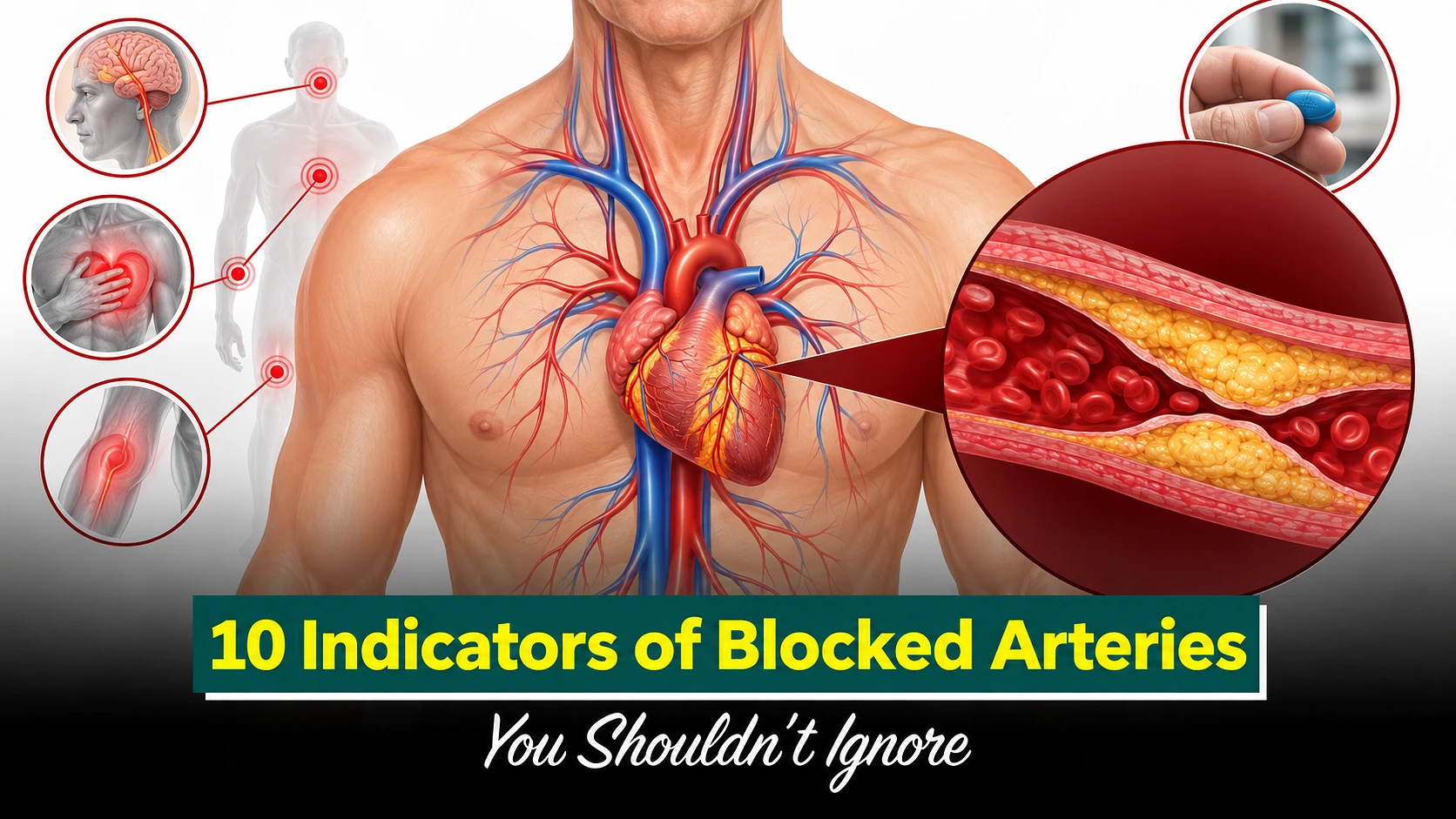
He had been buying tablets for erectile dysfunction over the counter for 2 years before his heart attack and never said a word about it to me or to his GP, and that is the detail I keep coming back to with this man, because the artery to the penis is 1 to 2 mm across and it silts up a good 2 or 3 years before the 3 to 4 mm coronary artery does. So the warning was there. It was in a pharmacy bag in his glovebox.
He is 66 now. Myocardial infarction (MI, the heart attack) 3 years ago, a stent put in the same week, and on top of that he has type 2 diabetes, high blood pressure, and peripheral arterial disease (PAD), which just means the leg arteries are narrowed as well as the heart ones. I see him every 6 months. He walked in this morning and told me he was fine and he mostly is.
How Blocked Arteries Show Up Before The Heart Attack
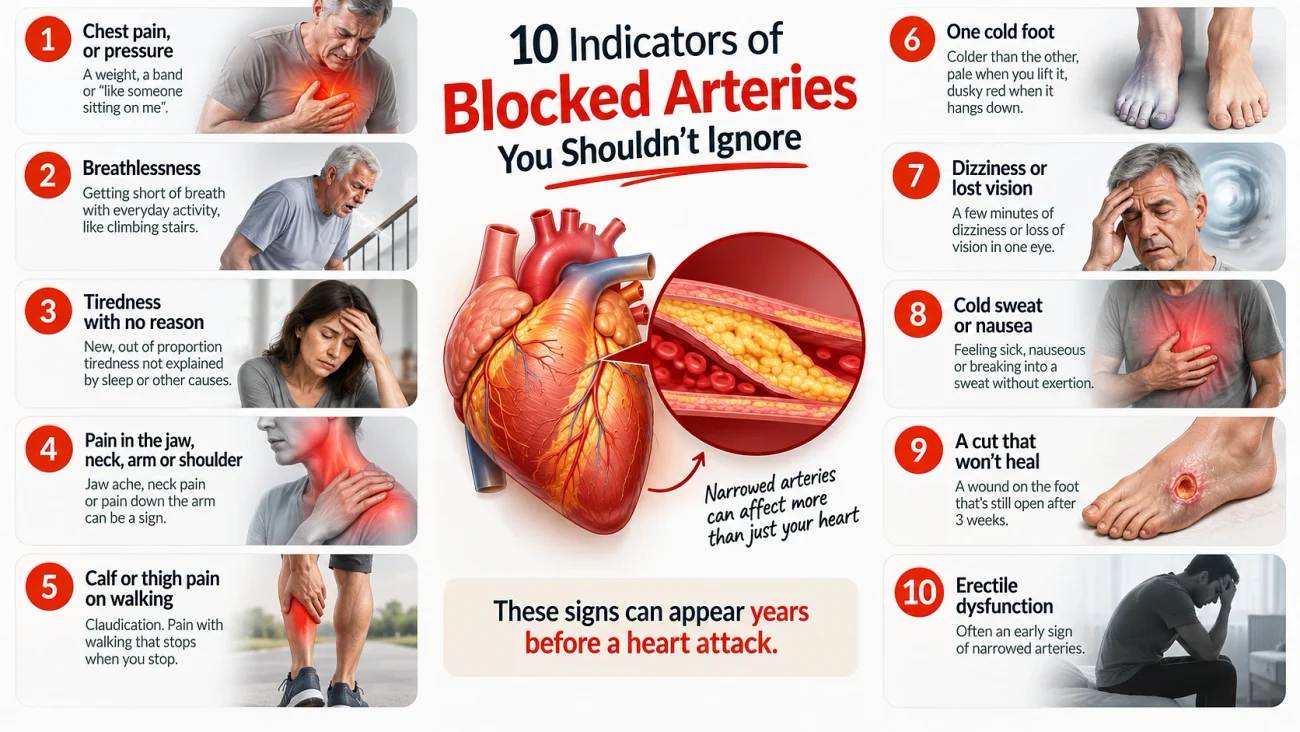
Plaque builds inside the wall of an artery, cholesterol and calcium and inflammatory cells packed together, and the vessel narrows slowly over years. At rest the narrowed artery still gets enough blood through. The trouble starts when the tissue downstream asks for more, so nearly everything on this list comes on with effort and goes away when you stop.1. Chest pain, or what patients will not call pain. Angina is the classic symptom of reduced blood flow to the heart muscle. People say pressure, a weight, a band, a fist, “like someone sitting on me”. It comes with stairs or cold wind or a big Sunday lunch, lasts 2 to 10 minutes, and settles with rest or a nitrate under the tongue. A sharp stab lasting a second, or pain you can bring on by pressing on your own ribs, is almost never the heart.
2. Breathlessness. A heart short of blood stiffens and pumps badly and the pressure backs up into the lungs. In diabetics and in older people this is frequently the only symptom there is. My patient had no chest pain at all before his MI. He had 6 months of stopping halfway up the stairs at work and putting it down to his weight, and his wife had noticed and he had not.
3. Tiredness with no reason for it. New, out of proportion, not explained by sleep or thyroid or anaemia or mood. Women report this more than chest pain in the weeks before an MI, which is one of the reasons women get diagnosed later.
4. Pain in the jaw, neck, arm, back or shoulder. The nerves from the heart share spinal segments with the nerves from the left arm and the jaw, so the brain files the signal in the wrong drawer. Jaw ache on walking that goes at rest is angina until somebody proves it is not.
5. Calf or thigh pain on walking that stops when you stop. Claudication, the leg version of angina. Predictable distance, same spot every time, gone in a few minutes of standing still. Everybody blames arthritis. Arthritis carries on hurting after you stop.
6. One cold foot. Colder than the other, pale when you lift it, dusky red when it hangs down. I feel for the pulses on the top of the foot and behind the ankle bone before I do anything else.
7. Dizziness, or a few minutes of lost vision in one eye. Narrowed carotid arteries in the neck. That one is same day, not next week.
8. Cold sweat or nausea with no exertion. The nervous system reacting to a heart under strain. This is the symptom people most often talk themselves out of.
9. A cut on the foot that is still open at 3 weeks. Or an ulcer over the toes or the outer ankle. Too little arterial blood getting down there to close it, and in a diabetic that is how amputations begin.
10. Erectile dysfunction. Already covered. Earliest sign on the list, least likely to be mentioned.
He had 4 of the 10 before his first event. Breathlessness, tiredness, claudication in the left calf, and the one in the glovebox.
Where He Stands Now, 3 Years On

- Blood pressure 128/76 mm Hg, pulse 62 beats per minute.
- Low density lipoprotein cholesterol (LDL-C) 58 mg/dL on a high intensity statin.
- Aspirin 81 mg daily, bisoprolol, an angiotensin converting enzyme (ACE) inhibitor, a long acting nitrate for the tightness on hills.
- No atrial fibrillation. Kidneys fine. Never had a gut bleed or a bleed in the brain.
That is optimal secondary prevention by any guideline you like, and he is still one of the highest risk people I will see this week. Disease in 2 arterial beds plus diabetes puts his chance of another MI, a stroke or a cardiovascular death somewhere around 5 or 6 in 100 every year, and it does not drift down to normal because the numbers on the blood form look good. So the question at every follow up is what else, and I put the same question to the registrars.
The Case Question
Despite successful revascularization and optimal medical therapy, his combined coronary and peripheral arterial disease leaves him at high risk of another ischaemic event. No atrial fibrillation, no bleeding history.
Which additional strategy should be considered to further reduce his long term risk of major cardiovascular events?
A. Add clopidogrel to aspirin for 1 year.
B. Replace aspirin with rivaroxaban 20 mg once daily.
C. Add rivaroxaban 2.5 mg twice daily to aspirin.
D. Add rivaroxaban 10 mg once daily to aspirin.
E. Replace aspirin with rivaroxaban 5 mg twice daily.
The Answer Is C, And COMPASS Is Why
The correct answer is C. Add rivaroxaban 2.5 mg twice daily to aspirin.
COMPASS (Cardiovascular Outcomes for People Using Anticoagulation Strategies) took 27,395 people with stable coronary disease or PAD and split them 3 ways: rivaroxaban 2.5 mg twice daily plus aspirin 100 mg, rivaroxaban 5 mg twice daily on its own, or aspirin 100 mg on its own.1 The data monitoring committee stopped it early, at a mean of 23 months, because the combination arm had already separated. I remember reading it on the train in 2017 and going back to check the dose twice because 2.5 mg twice a day is such a small amount of rivaroxaban, about a quarter of what we give for atrial fibrillation.
What it showed:
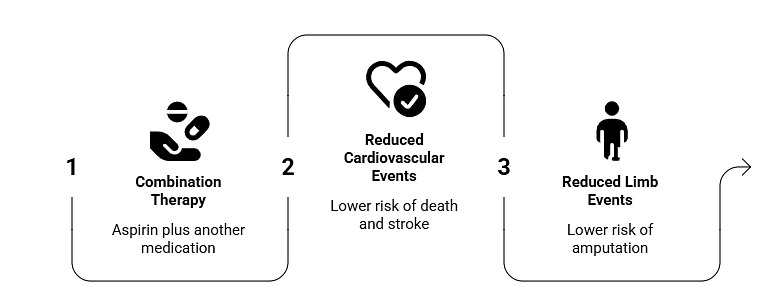
- Cardiovascular death, stroke or MI: 5.4% on aspirin alone, 4.1% on the combination, hazard ratio 0.76 (95% confidence interval 0.66 to 0.86).
- All cause death went down as well, which very few secondary prevention drugs manage.
- Major bleeding went up, 1.9% to 3.1%, hazard ratio 1.70. Mostly from the gut, mostly inside the first year, and no significant rise in fatal bleeds or bleeds into the brain.1,2
- In the 7,470 with PAD, major adverse limb events, amputation included, fell by 46%.3
The reasoning behind the tiny dose is that aspirin only blocks the platelet side of a clot forming on a cracked plaque, and thrombin is doing the other half of the work. A quarter dose of rivaroxaban knocks factor Xa back enough to slow the thrombin without turning the patient into someone who bleeds like a full anticoagulant, and the trial people called it dual pathway inhibition. Neither drug at those doses would protect anyone with atrial fibrillation from a stroke, and it was never meant to.
For him the PAD is what settles it. The 2023 AHA/ACC chronic coronary disease guideline gives this combination a class 2a recommendation in patients without high bleeding risk, strongest in PAD and polyvascular disease, and he is both.4 No gut bleed, no intracranial haemorrhage, kidneys normal, sinus rhythm, so nothing in his chart argues the other way. Therefore, option C.
I have put maybe 40 patients on it since. 2 came off for nosebleeds that would not behave, 1 for a gut bleed in month 7 that needed an endoscopy and a transfusion, and that one still bothers me, although he was also on a course of naproxen from a walk in centre that I did not know about. The rest are on it and doing fine, as far as I can tell, which with prevention is always the problem, you never get to see the heart attack that did not happen.
What He Was Told Before He Went Home
Rivaroxaban 2.5 mg twice daily started this afternoon, aspirin stays. Black stools, blood in the urine, a nosebleed past 20 minutes, he rings the clinic the same day, and I said it twice because the bleeding risk sits highest in that first year. He asked if the legs would get better. Honest answer, no, the drug keeps the leg attached and it does nothing at all for the claudication, and the only thing that does is walking through the pain 3 times a week for 30 to 45 minutes until the collateral vessels grow. He pulled a face. Most of them do. Bloods and a review in 6 weeks, then back to 6 monthly if the stools stay the right colour.
References:
- Eikelboom JW, Connolly SJ, Bosch J, et al. Rivaroxaban with or without aspirin in stable cardiovascular disease. N Engl J Med 2017;377:1319-30.
- Eikelboom JW, Bosch JJ, Connolly SJ, et al. Major bleeding in patients with coronary or peripheral artery disease treated with rivaroxaban plus aspirin. J Am Coll Cardiol 2019;74:1519-28.
- Anand SS, Bosch J, Eikelboom JW, et al. Rivaroxaban with or without aspirin in patients with stable peripheral or carotid artery disease: an international, randomised, double-blind, placebo-controlled trial. Lancet 2018;391:219-29.
- Virani SS, Newby LK, Arnold SV, et al. 2023 AHA/ACC/ACCP/ASPC/NLA/PCNA guideline for the management of patients with chronic coronary disease. Circulation 2023;148:e9-e119.