If your adult son is under mental health services and the council keeps brushing off your safeguarding concerns, put your concern in writing as a formal safeguarding referral under Section 42 of the Care Act 2014, address it to the local authority’s adult safeguarding team rather than his care coordinator. Once a concern meets the Section 42 threshold, the council has a legal duty to make enquiries. A phone call that gets passed to his mental health team and quietly dropped is not the same thing as a decision, and the difference matters enormously when you need to escalate.
Plenty of parents live inside this exact situation. A son or daughter with serious mental illness, often sleeping rough, sometimes using substances, refusing help one week and asking for it the next, while every service points at another service. The professionals are not necessarily heartless. The system is built around consent and thresholds, and families get stuck in the gap between “he has capacity to refuse” and “he is clearly not safe.” What follows is a practical route through that gap, based on how the law in England actually works.
What a Safeguarding Assessment Actually Is
People use the phrase loosely, and councils sometimes hide behind the confusion, so it helps to separate two different legal duties.
A safeguarding enquiry under Section 42 of the Care Act 2014 kicks in when a local authority has reasonable cause to suspect that an adult in its area has care and support needs, is experiencing or at risk of abuse or neglect, and cannot protect himself because of those needs. Abuse here includes exploitation by members of the public, financial abuse, physical harm, and self-neglect, which covers someone deteriorating on the street while refusing support.
A needs assessment under Section 9 of the same Act is broader. The council must assess anyone who appears to need care and support. His refusal to engage does not automatically end this duty, because the Act contains an exception where the person lacks capacity or is at risk of abuse or neglect.
Why Your Verbal Concerns Keep Disappearing
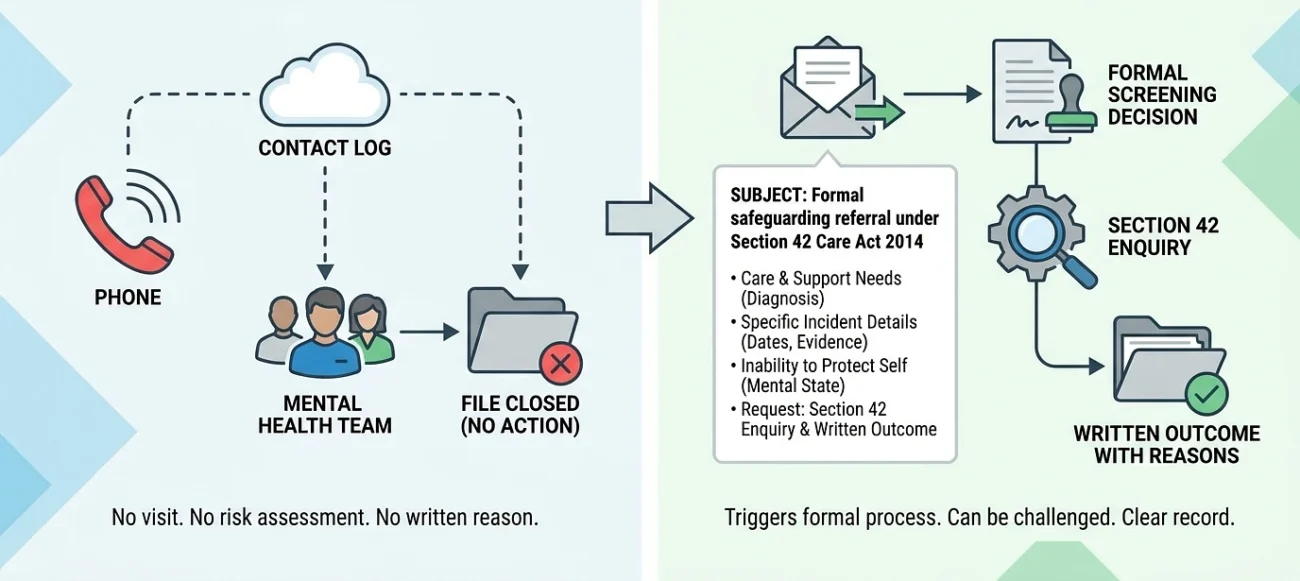
When you phone social services and describe your worries, the typical pathway looks like this. The call handler logs it as a contact, someone rings his community mental health team, the team confirms he is “known to services,” and the file closes. Nothing in that loop requires anyone to visit him, assess the risk, or write down why no further action was taken.
Written referrals behave differently. They create a paper trail, they usually trigger a formal screening decision, and that decision can be challenged. So the single most effective change you can make is to stop reporting concerns by phone and start sending them by email with a clear heading such as “Formal safeguarding referral under Section 42 Care Act 2014.”
Your referral should set out, in plain factual language:
- Who he is and confirmation that he has care and support needs, referencing his diagnosis and his involvement with mental health services.
- The specific incidents that show he is at risk from members of the public, with dates, locations, and any evidence you hold, such as messages, photographs, witness accounts, or police incident numbers.
- Why he cannot protect himself, linking his out of character behaviour directly to his mental state rather than describing it as a lifestyle choice.
- What you are asking for, namely a Section 42 enquiry and a written outcome with reasons.
Send it to the adult safeguarding team, copy in the head of adult social services, and keep every reply. The Social Care Institute for Excellence publishes detailed guidance on how these enquiries are supposed to run, which is useful ammunition when a council claims the threshold is not met.
The Consent Problem, and What It Does Not Mean
You will hear the word consent constantly. He is an adult, he has to agree, we cannot force him. All partly true, and routinely overstated.
Consent governs what support he accepts. It does not switch off the council’s duty to make safeguarding enquiries where he cannot protect himself, and it does not stop professionals from assessing whether he has mental capacity to make the specific decision to refuse help. Capacity under the Mental Capacity Act 2005 is decision specific and time specific. A man in the grip of psychosis who believes strangers are his friends may retain capacity to buy a coffee while lacking capacity to weigh the risk those strangers pose to him.
Requesting a Mental Health Act Assessment
There is a second lever families rarely know about. If you are his nearest relative under the Mental Health Act 1983, which a mother often is, Section 13(4) gives you the right to require the local authority to arrange for an Approved Mental Health Professional to consider whether he should be assessed for admission to hospital. If the AMHP decides not to make an application, the law obliges them to give you the reasons in writing.
This is not about punishing him with a section. It forces a qualified professional to lay eyes on the situation and commit reasons to paper, which is exactly what has been missing. Mind’s legal information pages explain the nearest relative role clearly, and Mind runs a legal advice line that can walk you through the wording.
Escalation Routes When the Council Still Does Nothing
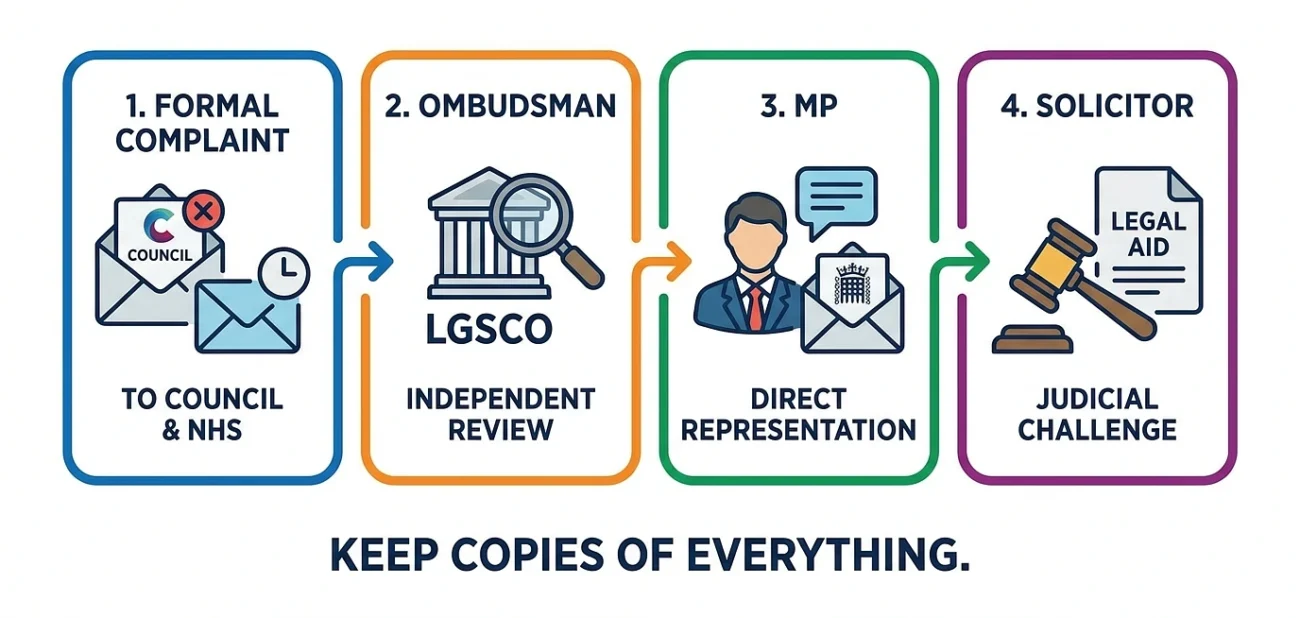
Assume you have sent the written referral and either received a refusal or silence. Work through these stages in order, keeping copies of everything.
Formal complaint to the council. Every local authority has a statutory adults’ social care complaints procedure. State that they have failed in their duties under Sections 9 and 42 of the Care Act, list the dates of your contacts, and ask for a response within their published timescale. Do the same with the NHS mental health trust through PALS if his care team has ignored risk information, and with the hospital trust if he has ever been discharged from A&E to the street.
The Local Government and Social Care Ombudsman. Once the council’s complaint process finishes, or if they drag it out beyond a reasonable time, take it to the LGSCO. The Ombudsman regularly upholds complaints about safeguarding referrals that were never properly screened, and its decisions are published, which councils dislike intensely.
Your MP. Write rather than phone, ask for a reference number, and request that they raise the case directly with the director of adult social services. MP letters land on senior desks that your emails never reach.
A community care solicitor. Failures to assess can be challenged by judicial review, and legal aid is available for community care cases where the person at risk qualifies financially, which someone street homeless almost certainly does. A solicitor’s pre-action letter frequently produces the assessment within days after months of stonewalling. The Law Society’s find a solicitor tool lets you filter for community care specialists, and charities such as Rethink Mental Illness can point you toward firms that take these cases.
Keeping Him Alive While the Paperwork Grinds On
None of the above happens quickly, and he is on the street now.
Report his rough sleeping through StreetLink, which alerts the local outreach team to his location. Outreach workers see people in crisis daily and can sometimes build trust where family and social workers cannot. If his mental state deteriorates sharply in public, the police can use Section 136 of the Mental Health Act to take him to a place of safety, so a 999 call in a genuine crisis is appropriate, not an overreaction.
He is also owed help under homelessness law. Someone with significant mental illness is likely to be in priority need, and he can approach the council’s housing options team himself, or you can support an application on his behalf with his consent. Shelter’s guidance sets out exactly what the council must do.
One last thing, and it matters as much as any legal route. You are a carer watching your child disappear into a system that keeps shrugging, and that takes a toll nobody measures. You are entitled to a carer’s assessment in your own right under Section 10 of the Care Act, and Carers UK offers advice and a listening ear from people who have stood where you are standing. Keep pushing, keep everything in writing, and do not let anyone convince you that persistence makes you the problem. The families who eventually get assessments done are almost always the ones who refused to go away.