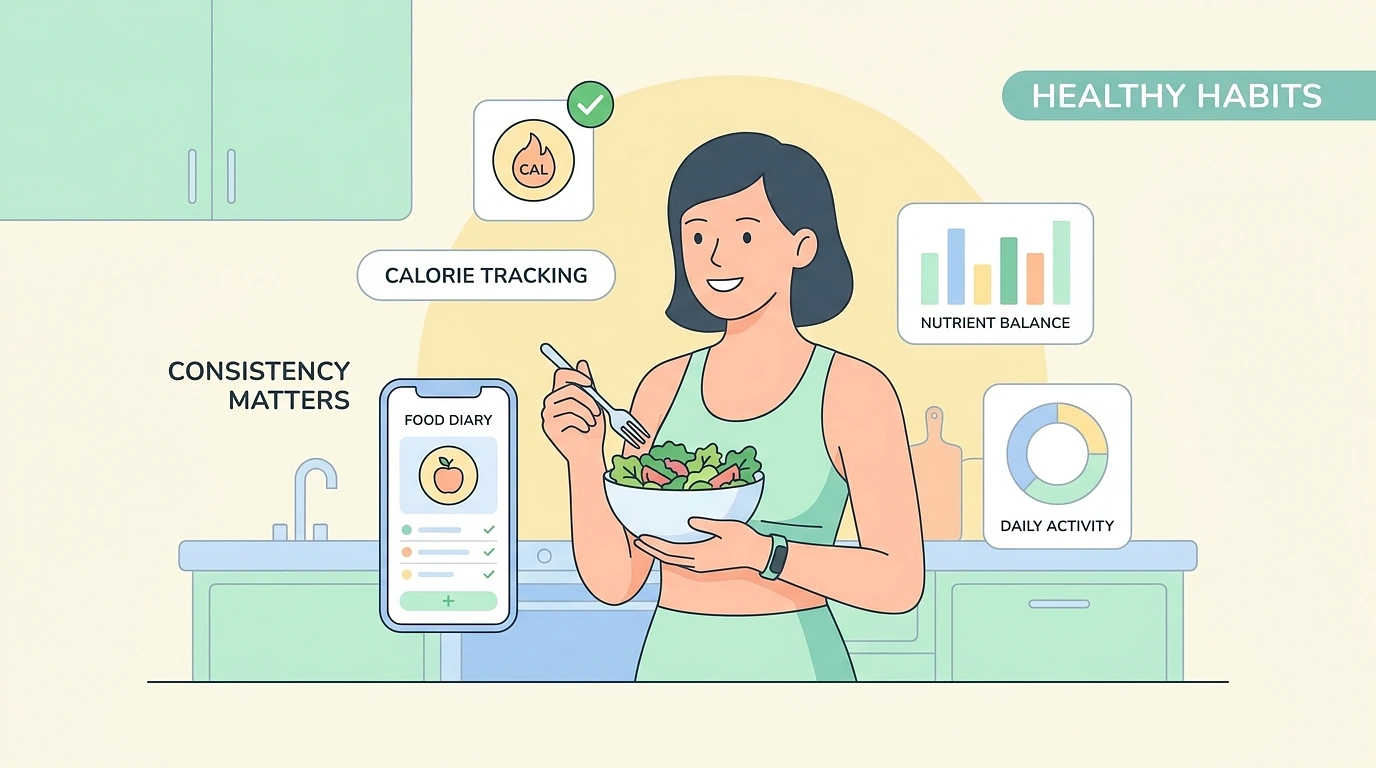
You’ve been eating clean. Hitting the gym. Doing everything right or so you think. But the scale won’t move, and you’re starting to wonder if your body is just broken.
Not in some dramatic, clinical way. In the completely ordinary way that every human brain misremembers food. We forget the bite we took off someone else’s plate. We eyeball a “tablespoon” of peanut butter that’s really three. We round down, always down, without realizing we’re doing it. And nutrition researchers have been documenting exactly how far off we are for over thirty years now.
The Experiment That Made Researchers Uncomfortable
In 1992, a group at St. Luke’s-Roosevelt Hospital in New York decided to settle an argument. They recruited 224 people who insisted they were eating very little around 1,200 calories a day and still couldn’t lose weight. These weren’t lazy people making excuses. They genuinely believed their diets should be working.
The researchers used something called doubly labeled water, which is the closest thing science has to a lie detector for calories. It measures what your body actually burns over days and weeks in the real world, not in a lab.
The gap was enormous. On average, people underreported what they ate by 47 percent. They also overreported their exercise by 51 percent. Think about what that means in practice. Someone swearing they ate 1,400 calories and burned 400 exercising? Probably eating over 2,000 and burning maybe 200. The math doesn’t just not add up it collapses.
Steven Lichtman, the lead author, didn’t mince words. These people weren’t failing at dieting. They were working from completely wrong numbers. The study ran in the New England Journal of Medicine, and the nutrition world has been grappling with it ever since.
Follow-up research over the next three decades has nudged the averages around, but the ugly truth hasn’t changed. Most studies land somewhere in the 20 to 40 percent underreporting range. And here’s the part that really stings it’s not just overweight people who do this. Lean, fit, health-conscious people underestimate too. Our brains simply weren’t built for this job.
If Everyone Wrong, Why Track at All?
Lori Burke and her team at the University of Pittsburgh dug through 22 different self-monitoring studies and published their findings in the Journal of the American Dietetic Association in 2011. The pattern was impossible to miss. People who wrote down what they ate lost more weight. Period. And the frequency of logging mattered more than anything else more than diet quality, more than the workout plan, more than how motivated someone felt at the start.
Then there’s the Kaiser Permanente trial from 2008. Big study 1,685 overweight and obese adults, all getting the same dietary guidance. The only thing that separated the winners from everyone else? Whether they kept a food diary. People who logged six or more days a week lost roughly double what the once-a-week loggers lost. Same program. Same advice. Same doctors. The diary was the difference.
Psychologists have a name for this. They call it the observer effect the simple act of watching yourself changes what you do next. You log Tuesday’s lunch and see it was heavier than you assumed. Wednesday, without anyone telling you to, you grab something lighter. That tiny, almost unconscious correction, repeated across hundreds of meals, is where the results come from. Not from having a perfect calorie count. From paying attention.
Here Why Most People Quit Anyway
One meal entry means opening an app, searching through a database, scrolling past seventeen things that aren’t quite what you ate, picking the closest match, guessing whether your portion was “medium” or “large,” and hitting save. Now do that for breakfast. And lunch. And dinner. And the handful of crackers you grabbed at 3 PM. And the oil you cooked with. You’re looking at 15 to 20 entries a day if you’re being honest about it.
Nobody keeps that up. The data from calorie-tracking apps confirms what you’d guess most users drop off within two weeks. They quit before the habit has time to actually change anything. The app worked fine. The human couldn’t sustain the effort.
This is the friction that newer tools are attacking head-on. If you can cut each entry from five minutes down to thirty seconds, more people survive the two-week wall. AI-powered calorie tracking apps take the approach of letting you snap a photo of your plate and doing the identification and estimation automatically. Is the calorie count perfect? No it’s typically within 10 to 20 percent of lab measurements for common foods. But perfection was never really the point. The point is whether you open the app again tomorrow.
The Precision Trap
Here’s a mistake that catches smart, motivated people more than anyone else: they decide that if they’re going to track, they’re going to do it right. Food scale. Measuring cups. Every gram weighed. Every label read twice.
Someone who logs every day with a 15 percent margin of error will, after three weeks, understand their diet better than someone who weighed everything to the gram for five days and then burned out. The consistent logger notices things that their “small” weeknight dinners are quietly running 700 calories, that the salad dressing alone accounts for a quarter of their lunch, that weekends blow past their weekday averages by a shocking amount. The precision logger doesn’t notice any of this, because they already stopped.
Consistency beats precision. That’s not a motivational slogan. It’s what the data shows, over and over.
Good reference numbers help, though. The USDA runs a database called FoodData Central that publishes calorie and macronutrient data for hundreds of thousands of foods, all sourced from actual chemical analyses and standardized nutrition labels. Apps that pull from FDC give you a grounded starting point not perfect, but defensible. Anyone can search it directly at FoodData Central when a number looks suspicious.
And if you haven’t started tracking at all, it helps to at least know your ballpark target. A TDEE calculator estimates your total daily energy expenditure using the Mifflin-St Jeor equation the same formula most registered dietitians rely on plugging in your age, weight, height, sex, and activity level. It won’t be exact, but it gives you a starting line that’s better than a guess.
What the Research Actually Wants You to Do
Strip away the jargon and thirty years of papers, and the advice is surprisingly simple.
- Track out of curiosity, not guilt. Your food log isn’t a punishment. It’s a flashlight pointed at a dark room. Most people are genuinely shocked by what the first two honest weeks reveal the “healthy” smoothie that rivals a McDonald’s shake, the handful of trail mix that casually packed 500 calories, the cooking oil nobody ever counts. That shock is the whole mechanism. It rewires your mental model without anyone lecturing you about macros.
- Zoom out to the week. Daily calorie totals bounce around and they’re supposed to. You eat more on active days, social days, stressful days. Staring at one bad Wednesday and starving yourself Thursday to “make up for it” is exactly the kind of restrict-then-binge cycle that wrecks people. A weekly average is a calmer, truer number. Act on that instead.
- A messy log today beats a perfect log you’ll abandon next month. Blurry photo, rough guess, logged in twelve seconds that entry is doing more for you than the precisely weighed chicken breast you stopped recording three weeks from now. The number one killer of food tracking isn’t inaccuracy. It’s the voice in your head that says if I can’t log this perfectly, I won’t log it at all. Ignore that voice.
- When a number looks wrong, check it. Tracking apps make mistakes. Food labels make mistakes. AI makes mistakes. USDA FoodData Central is free, public, and searchable. A two-minute lookup catches bad data before it snowballs into bad decisions.
The Boring Truth
The central finding of three decades of nutrition research could fit on an index card people who pay attention to what they eat do better than people who don’t. That was the takeaway in 1992 and nothing published since has seriously challenged it.
What’s changed is the cost of paying attention. It used to require a notebook, a calorie book, and more patience than most humans possess. Now it takes a phone and a few seconds. When logging a meal becomes easier than ordering one, more people actually do it. And more people doing it sloppily, imperfectly, with all the estimation errors baked in is the whole game.