The kitchen in my last flat had a strip light in the ceiling and a counter that was never clear, and for a year I stood in that room every evening feeling vaguely annoyed and blamed my job. The new flat has a window over the sink and a lamp on the side, and the annoyance went. Same job, same person, different room. It took me an embarrassingly long time to admit that the room had been doing most of that.
A home does not have to be beautiful to make you feel better. It has to stop working against you. Most of the ways a home works against us are small, physical and fixable: the light, the noise, the temperature, the pile on the chair, and where the keys live.
What Clutter Does To Your Attention
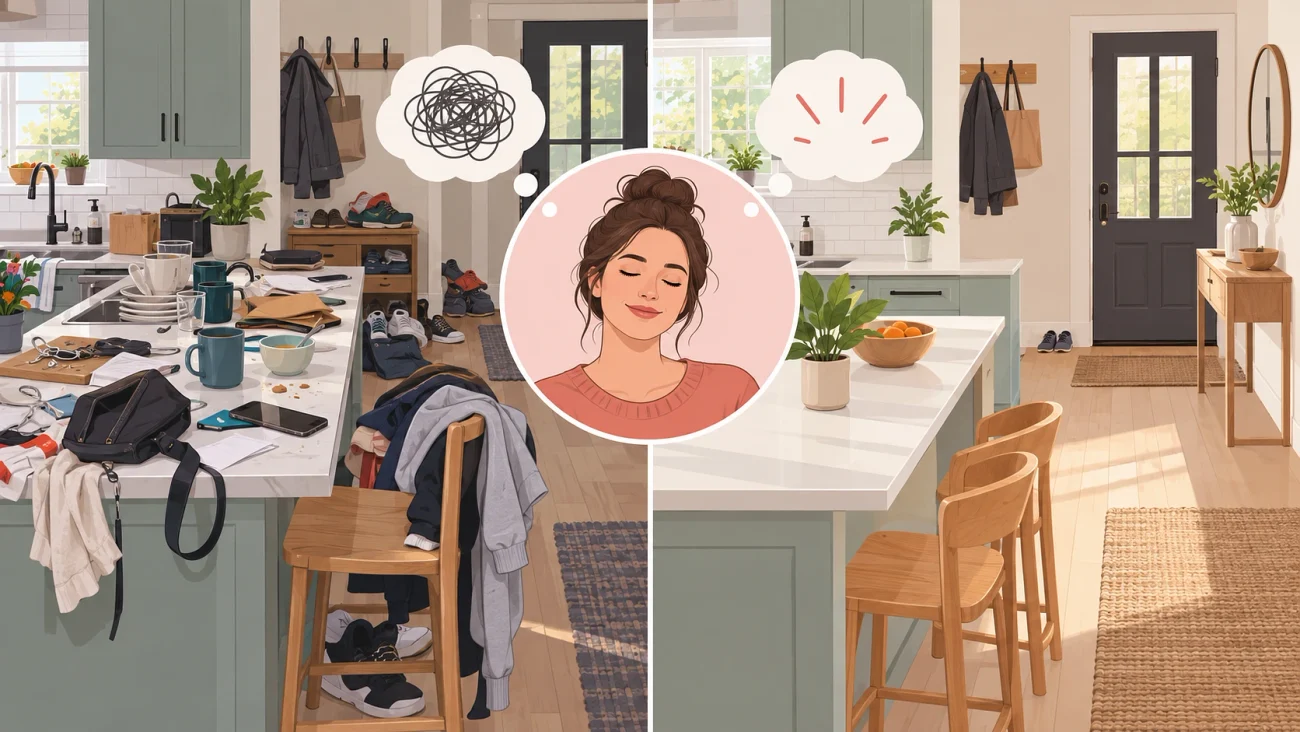
Walk into a room where everything has a place, then into one where clothes are on the chair, the sink is full and the keys are somewhere. Nothing dramatic has happened in the second room, and you feel worse in it anyway. That is your attention doing extra work. Every object in your line of sight is something the brain has to register and dismiss, and a counter with 40 things on it asks for 40 small decisions each time you look at it.
A messy home does not mean an unhappy person. Real homes with children, pets, work and hobbies are messy by lunchtime. The trouble is clutter that never moves, the stuff that sits in view for weeks because nobody has decided where it goes. Housing research that asks people how they feel about their homes keeps finding cleanliness and clutter on the list, alongside light, noise and air.
The 2 Surfaces To Clear First:
- The kitchen counter, because you look at it 20 times a day.
- The surface nearest the front door, because it is the first and last thing you see.
- Then give the things that always land on those surfaces a permanent home, and the surfaces stay clear on their own.
Nobody needs a minimalist flat. We need the 2 surfaces we look at most to be clear.
How Lighting Changes A Room Faster Than Anything Else
Lighting is the change people skip because we only notice light when it is wrong. A room in daylight and the same room under one harsh ceiling bulb are 2 different rooms. Research on home lighting and health is mixed on the detail and steady on the basics: bright, cool light in the evening keeps the body on daytime settings, and dim, warm light lets it wind down.
Match The Light To The Job
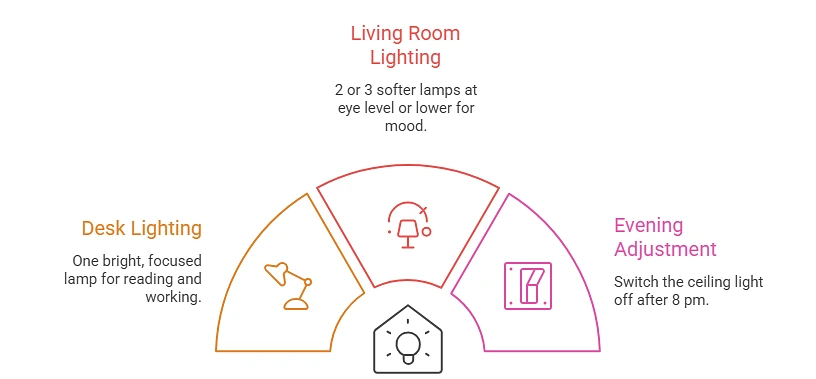
- A desk wants one bright, focused lamp for reading and working.
- A living room wants 2 or 3 softer lamps at eye level or lower, so the mood can come down as the evening goes on.
- After about 8 pm, switch the ceiling light off in whichever room you are in and see what happens to the room.
None of that needs an electrician. Moving a lamp, opening the curtains first thing, or shifting the reading chair to the window are the changes we actually notice.
Why 2 Clean Rooms Can Feel Completely Different
A room of polished surfaces, glass and sharp edges and a room of wood, fabric, cushions and baskets can both be spotless and feel nothing like each other. Colour works the same way. Some of us relax in strong colour and some only relax in muted shades, and there is no single colour that calms everyone, whatever the paint chart says.
Texture is the part most people miss. A rug underfoot, a chair that is genuinely comfortable, wooden furniture, curtains instead of blinds, all of these add a physical warmth that tidiness on its own cannot. Notice your own reaction to a room rather than following a rule about which colours are supposed to be calming. The magazine was not written for the person who lives in your house.
The Noise, Heat And Stale Air You Have Stopped Noticing
Sometimes the problem in a room is nothing you can see.
The traffic outside, the fridge that hums, the neighbours’ television through the wall, the extractor fan that never fully switches off. We stop hearing these after a while and they carry on wearing at us anyway. A room that is always slightly too cold or too warm does the same, and so does stale air; ventilation, humidity and indoor pollutants turn up in study after study on housing and wellbeing, right next to lighting and noise.
The space around the house counts here too. A drive full of bikes, tools and a van that never moves is clutter we walk past every day, and giving all of that a covered, fixed spot with a custom metal carport does for the outside what a clear counter does for the kitchen. Everything has a place, and the place is not your eyeline.
3 Fixes That Cost Almost Nothing
- Open the windows for 10 minutes every morning, winter included.
- Find the one persistent noise and deal with it, whether that is a rubber pad under the washing machine or a heavier curtain on the road side.
- Set the temperature for the activity: warmer where you sit still, cooler where you sleep.
How Room Layout Quietly Decides Your Habits
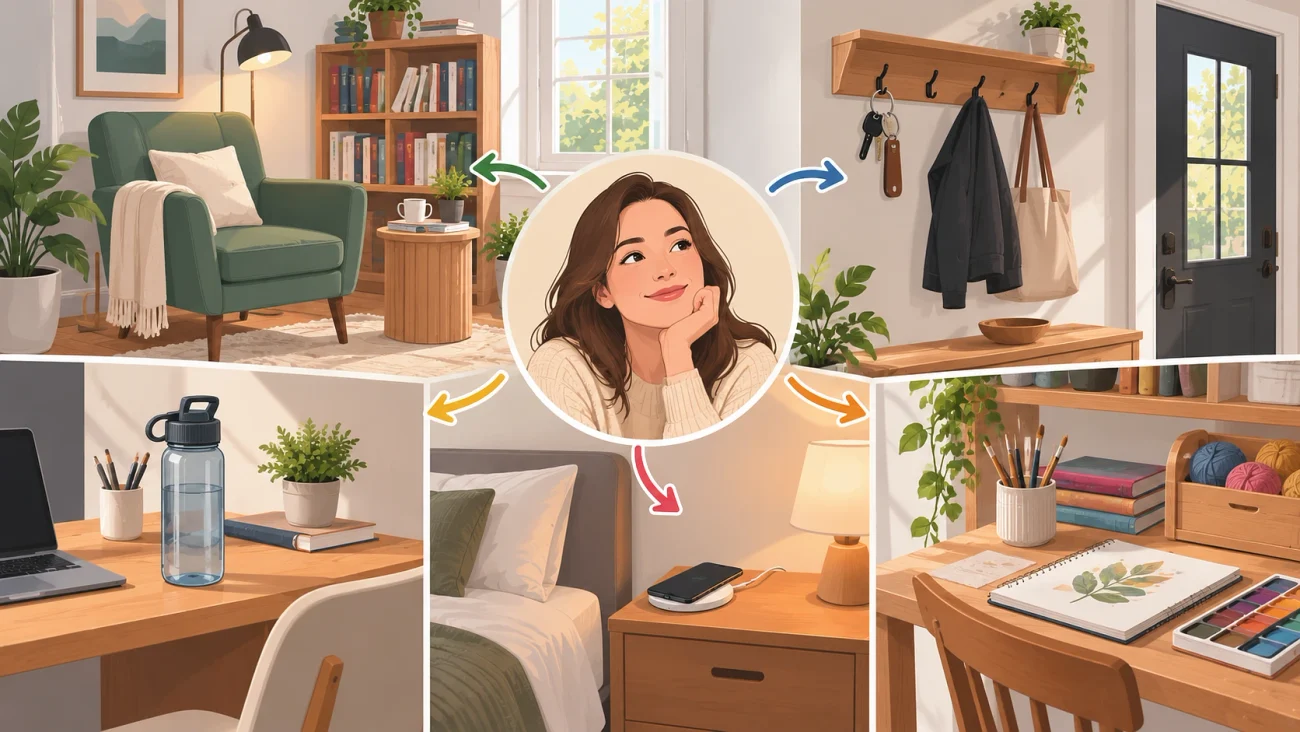
A home nudges us towards certain habits whether we planned it or not. If the reading chair is comfortable and the books are within reach, we read. If the walking shoes are under a pile in the hall, a walk needs another decision first, and most evenings the decision loses. If the keys have a hook by the door, we stop losing them.
This is designing the room around the behaviour you want, instead of relying on willpower.
- Want to drink more water? A bottle on the desk, in sight.
- Want to stop scrolling in bed? The phone charges in the kitchen.
- Want to draw, play or sew more often? The kit lives on a shelf, not in a box in a cupboard.
A home set up this way does a share of our self discipline for us, quietly, every day, without being asked.
How One Room Can Do 4 Jobs Without Feeling Like An Office
Most of us work at the dining table in the morning, cook in the afternoon, sit on the sofa in the evening and have friends round in the same room at the weekend. Nobody has a room per activity. What works is a corner per activity.
A desk in one corner says work. A chair by the window says reading. A clear patch of floor by the television says stretching. Those small boundaries stop the whole home feeling like one large, tired workspace, and they make it far easier to leave work at the desk when the desk is a defined place.
Why The Objects With A Story Matter More Than The Expensive Ones
A beautiful room can still feel as if nobody lives in it. What makes a room feel like home is usually not the furniture. It is the photographs, the books we have actually read, the picture a child painted, the terrible souvenir from the trip we still talk about, the chair we inherited and cannot throw out. Plants and a view of anything green belong on the same list; access to gardens, balconies, plants and greenery keeps appearing in the housing research as something that measurably helps.
Your home should tell your story rather than copy somebody’s mood board.
12 Changes That Need No Budget And No Builder:
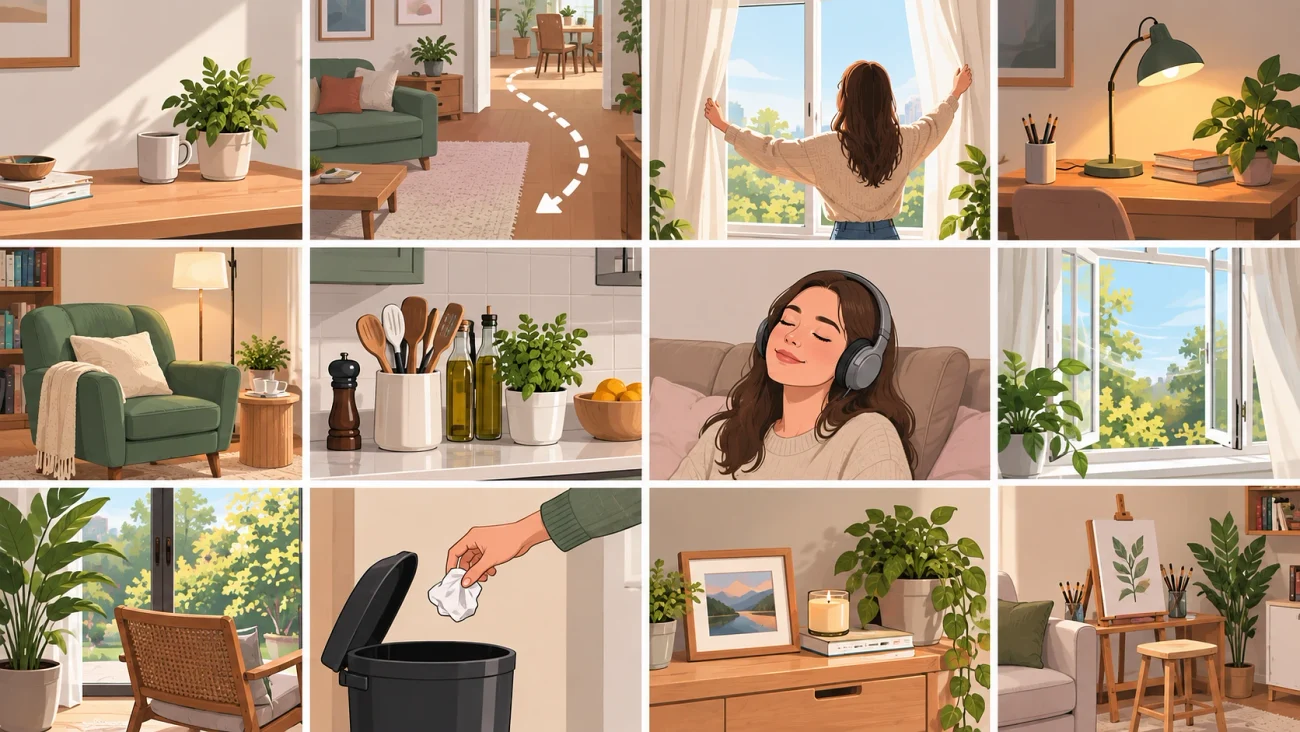
- Clear one surface you look at every day.
- Move a piece of furniture so the walking route through the room is straight.
- Let more daylight into the room you use most.
- Put a lamp where you read or work.
- Make one comfortable place for doing nothing.
- Keep the things you use daily within arm’s reach of where you use them.
- Find and fix one background noise.
- Open the windows every morning.
- Add a plant, or turn a chair to face the garden.
- Remove the one object that irritates you every time you see it.
- Put out 3 personal things that make you glad to see them.
- Give each activity its own corner.
The changes that count are the ones you notice on a Tuesday, not the ones that photograph well.
What A Home That Works Looks Like
There is a pressure now for every home to look coordinated and camera ready, and it is worth ignoring. A family home has toys on the floor. A reader’s home has books on every surface. A cook’s kitchen has a crowded counter. A home worker has a desk in the bedroom. None of those is a failed home. The better question is whether the place makes an ordinary day easier, more comfortable and more like your own.
A home is the backdrop for the mornings, the arguments, the good news, the bad days and the sleep. We cannot control all of it. We can control the lamp, the counter, the window and the hook by the door, and that is usually where feeling better at home starts.